How to Find Office Tenants: A Step-by-Step Guide

Key Takeaways
- Commercial office leasing typically takes three to six months from first marketing to signed lease. Start marketing for a replacement tenant six to nine months before your current lease expires to avoid a costly vacancy gap.
- Your listing is your first showing. A complete listing with professional photography, floor plans, and direct contact information generates qualified inquiries. An incomplete one generates tire-kickers.
- Filling a vacancy with the wrong tenant can cost more than leaving it empty. Between lost rent, legal fees, broker commissions, and a fresh TI allowance, replacement costs on a mid-size office space can easily reach six figures.
Filling an office vacancy can take longer than many investors expect. Unlike residential rentals, commercial office leasing typically runs three to six months from the first inquiry to a signed lease, and can go even longer in softer markets. Meanwhile, you're still making financing payments, taxes, insurance, and utility costs while you wait to find an office tenant.
The good news is that the process is learnable and largely repeatable. Here's what actually moves the needle.
Step 1: Market Your Office Space Where Tenants Are Already Looking
Your listing is your first showing. Most prospects will judge your property before they even contact you, so getting your listing right isn't a finishing touch, it's a starting point.
Start with the right platforms.
Most commercial tenants begin their search online, which means having a digital listing is table stakes. A well-placed listing on the right platform puts your property in front of tenants and their brokers at the exact moment they're actively searching.
LoopNet is the dominant public-facing platform for office listings. It's where the majority of tenants begin searching for an office space for lease and where brokers go to validate availability. CoStar sits behind it as the professional-grade database that brokers use for comp research and tenant prospecting.
Don't overlook the sign out front.
Physical signage still generates real inquiries, particularly for buildings on high-traffic corridors. Professional signage with clear contact information and available square footage functions as a 24/7 lead generator and signals active management to prospective tenants.
Listing quality determines inquiry quality.
A half-completed listing with one blurry exterior photo attracts tire-kickers. A complete listing pulls qualified prospects.
At minimum, include:
- Professional photography of key spaces
- Floor plan
- Ceiling heights
- Parking ratio
- Asking rent per square foot
- Direct contact name and phone number placed at the top of the listing
Tenants won't schedule a tour without enough information to justify the trip, and they generally won't ask you to fill in the gaps. They'll just move on.
To get a sense of how competing office spaces in your area are priced and marketed, browse current office listings near you.
Office Spaces For Lease
Step 2: Decide Whether to Hire a Broker
A broker gives you access to distribution channels that are difficult to reach independently. They maintain active networks of tenant representatives, corporate decision-makers, and businesses actively looking for new space. That reach is difficult to replicate independently, especially if you're new to office leasing.
What a broker brings to the table.
On the landlord side, a listing broker markets your property, fields inquiries, qualifies prospects, and negotiates lease terms on your behalf. They also have CoStar access, which means your vacancy gets in front of brokers representing tenants and not just tenants searching on their own.
Landlord-side broker fees typically fall in the range of 4-6% of total lease value, though structures vary by market. In many markets, the total commission is split between the landlord's broker and the tenant's broker, meaning each side may receive 3% rather than the landlord paying 4-6% to a single broker.
What you can reasonably handle yourself.
Most owners can handle initial marketing on their own without much risk. Setting up a LoopNet listing, installing signage, and doing some local networking are all low-stakes tasks that don't require specialized expertise.
Where it gets more consequential is lease negotiation and tenant qualification. Inexperience can be expensive in both areas, regardless of how you find a tenant. If you're not experienced in both, plan to involve a broker or real estate attorney before you get to that stage, even if you sourced the prospect yourself.
The DIY vs. broker calculation.
Before deciding that a broker is too expensive, run the numbers: Add up your time cost, including hours spent marketing, showing, and negotiating, direct marketing expenses, and vacancy carrying costs, then compare that to the cost of hiring a broker. Running this calculation helps you decide whether hiring a broker makes financial sense for your vacancy.
Consider the tradeoffs of DIY leasing vs. using a broker:
| Cost Factor | DIY | With a Broker |
|---|---|---|
| Listing platforms | You pay directly | Included in broker's marketing |
| Photography and signage | You pay directly | Often coordinated by broker |
| Time cost | High: you handle showing, negotiating, and qualifying tenants falls on you | Low: broker handles most of the process |
| Lease negotiation risk | High if inexperienced | Mitigated by expertise |
| Vacancy carrying costs | Longer potential vacancy without access to broker networks | Shorter potential vacancy through established tenant relationships |
| Commission | None | Typically 4-6% of total lease value |
There are good reasons to hire a broker even when you're capable of handling the process yourself. Access to tenant networks and lease negotiation experience are the two that tend to matter most.
Step 3: Screen Tenants Before You Commit
Filling a vacancy with the wrong tenant can cost more than leaving it empty. If you bring on a bad tenant and they stop paying rent, your losses compound quickly: You're covering debt service and operating expenses out of pocket, potentially paying legal fees to remove them.
This chart shows a hypothetical best and worst-case scenario for the cost of a bad office tenant, based on a 5,000 square-foot office at $25/sq ft annual rent. TI allowance varies significantly by market and lease terms. All figures are illustrative.
Then you have to start the leasing process over, which means another round of broker commissions and, in many cases, a fresh TI allowance for the next tenant. On a 5,000 square-foot space, those replacement costs alone can easily run into the six figures before you've collected a single dollar of new rent.
With that in mind, screening isn't just a bureaucratic process. It's a vital step in protecting your cash flow.
Establish baseline requirements up front.
Before you start showing the space, decide what a qualified tenant looks like. At minimum, require:
- Two to three years of business financial statements
- A business credit check
- Verification of how long the company has been operating
- References from prior commercial landlords
- Proof of business insurance
A business that can't provide these materials is telling you something.
Check for red flags.
Some patterns consistently predict tenant problems. Watch for:
- Rent-to-revenue ratio above 10-15% depending on industry (rent should be a manageable operating expense, not a stretch)
- Less than two years in business with no strong personal guarantee to offset the risk
- Unexplained revenue gaps or inconsistencies across financial statements
- Pushback on providing documentation or signing a personal guarantee
- Frequent changes to deal terms after initial agreement
Many of these will surface somewhere in the application package. Financial statements, tax returns, and a signed authorization to run a business credit check are the most reliable places to look. For prior landlord references, consider making the call directly. A previous landlord may say something on the phone they wouldn't put in writing.
Tenant screening requirements and lease terms vary by state and local law. Consult a real estate attorney before finalizing your qualification criteria and lease structure.
Balance screening standards against vacancy costs.
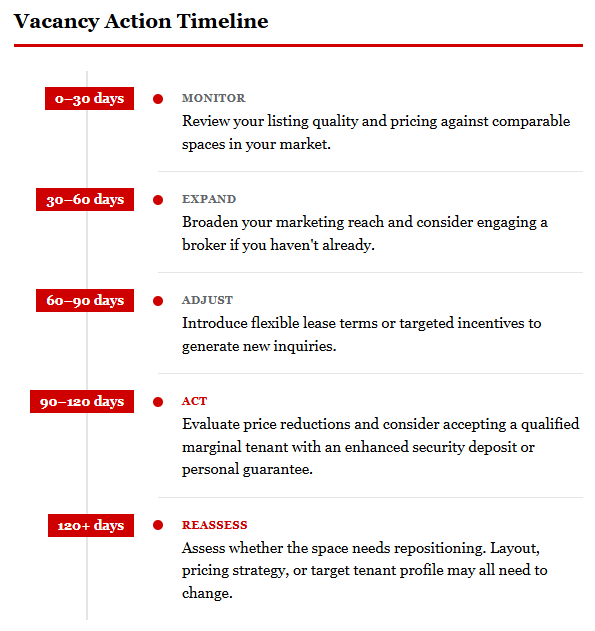
Holding out for a perfect tenant while carrying vacancy costs has a real price. In most markets, if you're past 90 days vacant, it may make sense to accept a qualified but marginal tenant with a larger security deposit or personal guarantee rather than continue waiting.
Step 4: Structure Your Lease Terms Strategically
Flexible lease structures directly expand your pool of qualified prospects by appealing to tenants who would otherwise choose a competitor or coworking space.
In modern office markets, many tenants put a premium on flexibility. They may want room to scale up, scale down, or exit if hybrid work patterns shift. By structuring your leases thoughtfully, you can let tenants self-select based on their risk tolerance, without giving space away.
Consider a tiered approach. Shorter terms like month-to-month or annual leases command premium rates. In most markets, three-year commitments with expansion options sit at market rate, and five-plus year leases with locked rates get a modest discount in exchange for the stability they offer. Structuring lease terms with flexibility in mind helps attract tenants who might otherwise choose a competitor.
Understanding the full range of commercial real estate lease terms and commercial lease types helps you structure these options correctly from the start.
Consider whether a coworking split works for your goals.
Some owners go further by carving out a portion of the building to offer coworking spaces to expand their tenant pool beyond traditional office users. It can attract tenants who might otherwise choose a flexible workspace provider, but it comes with real operational overhead. Consider the coworking vs. office investment tradeoffs, and verify whether there's demand for coworking spaces in your market first.
Step 5: Build Relationships That Bring Tenants to You
Commercial leasing is relationship-driven in a way that residential leasing isn't. Many businesses decide to relocate or expand after a conversation with their attorney, accountant, or a peer in their industry. Getting in front of those conversations means building relationships before you have a vacancy to fill.
Build relationships with prospective and existing tenants.
Local business associations, chamber events, and professional networking groups are worth your time. So are the tenants already in your building. A satisfied existing tenant may know other business owners, and a recommendation from a peer carries more weight than any listing.
Check in with current tenants regularly, not just at renewal time. Regular tenant check-ins surface expansion opportunities before tenants start searching for new space. Expansion conversations are some of the easiest tenant placement opportunities you'll ever find.
Frequently Asked Questions
How long does it typically take to find a qualified office tenant, and when should I start getting concerned about vacancy costs?
Office leasing typically runs three to six months from first marketing to signed lease. Start replacement marketing six to nine months before your current lease expires to avoid a gap. If space sits vacant, use time-based triggers: at 30 days, review pricing and marketing reach; at 60 days, consider engaging a broker if you haven't already; at 90 days, evaluate flexible lease terms or price reductions; and at 120 days, assess whether to reposition.
Should I hire a commercial real estate broker or market the space myself, and how do I decide which approach makes financial sense?
The DIY-versus-broker decision comes down to one question: What is your vacancy costing you daily? Factor in carrying costs, your time, and lease negotiation risk against a typical broker fee of 4-6% of total lease value. If you haven't generated qualified prospects within 60 days of listing, that's your signal to bring in professional help.
What lease concessions or incentives should I offer to attract tenants without sacrificing too much profitability?
Lead with low-cost, high-perceived-value concessions: flexible terms, faster build-out timelines, and responsive maintenance commitments. Reserve costly concessions like substantial TI allowances or extended rent abatement for two situations: when you're past 90 days vacant, or when you're competing for a strong long-term tenant. A tenant with proven stability and a lengthy lease commitment justifies the upfront cost.
